

Download it on:
Puppy Biting: Why It Happens and How to Redirect It
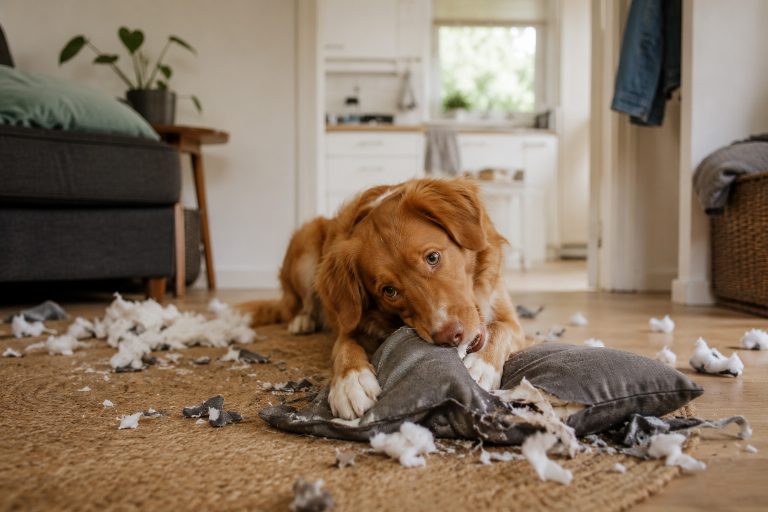
Somewhere around week two of having a puppy, most new owners ask the same question at the same volume: why does this tiny animal want to eat my hands?
The honest answer is — they’re not being aggressive, and they’re not broken. Biting at this age is almost entirely normal, and it comes from a few overlapping things: sore gums from teething, a puppy’s natural way of playing, and the fact that hands and feet moving around are, frankly, the most exciting thing in the room to a young dog.
There’s also something happening developmentally that’s worth knowing. Puppies learn to control the force of their bite — something called bite inhibition — through feedback from littermates during play. A bite that’s too hard gets a yelp, a withdrawal, a pause. That feedback loop teaches them to soften their mouth over time. Puppies who come home early or get limited social play with other dogs sometimes miss part of that lesson, which is part of why your hands end up doing some of that teaching instead.
None of that means you have to just put up with it for months. It means redirection works better than punishment — you’re not trying to stop the urge to bite, you’re giving it somewhere appropriate to go.
1. Knot-a-pus Toy
Tie the legs of an old t-shirt or towel into a rough octopus shape, hide a few treats inside the knots, and hand it over the moment your puppy starts going for hands, sleeves, or pant legs.
Untying the knots takes real jaw work and problem-solving, which means it scratches the same itch as biting your arm — just on something that’s actually meant for it.
The idea: give your puppy something legal to bite, fast, before the illegal option becomes a habit.
2. Home Lick Mat
Spread plain yogurt or a bit of soft, dog-safe wet food across a lick mat — or just a flat plate if that’s what you have.
This one’s less about jaw work and more about state of mind. A lot of biting happens when a puppy is overstimulated or overtired and doesn’t know how to come down from that. Licking is slow and repetitive, and it has a genuinely calming effect — it gives an overexcited puppy a way to shift out of “bite mode” without a confrontation.
The idea: licking calms the mouth, and the mind tends to follow.
3. Treat Trail
Drop a short trail of treats across the floor, a few steps apart, leading to one final reward. Let your puppy follow it nose-first.
This works especially well in the moments your puppy is jumping at your legs or grabbing at your sleeve out of pure excitement. A scent trail switches their attention from your hands to the floor almost instantly.
The idea: redirect the teeth by turning on the nose instead.
4. Chew Swap Game
When your puppy bites something they shouldn’t — your hand, the corner of a cushion — calmly offer a better option: a soft toy, a rope, a puppy-safe chew. The moment they let go of the wrong thing and take the right one, praise them.
This isn’t a strict “leave it” command. It’s gentler than that — closer to “not this, this instead.” Over time, the swap becomes the default response, without ever needing a correction.
The idea: your puppy learns biting is allowed — just not on you or your furniture.
5. Bite Break Tug
Grab a longer, soft tug toy. Play for 20–30 seconds, then pause. If your puppy goes for the toy, the game continues. If they go for your hands instead, the game stops immediately — no scolding, just a brief pause until they try the toy again.
It’s a small distinction, repeated enough times that it sticks: hands mean the fun stops, toy means it continues.
The idea: turn biting energy into a short, structured game with clear rules your puppy can actually learn from.
A Quick Note on Timing
Puppy biting tends to peak somewhere around 12–16 weeks, often lining up with new teeth coming in, and it generally eases up by six to seven months as adult teeth finish coming in and bite inhibition matures. If your puppy is mouthy mostly during play and excitement rather than out of fear or aggression, that’s the normal version of this phase — frustrating, but temporary, and very responsive to redirection.
If biting ever seems driven by fear, sudden aggression, or doesn’t improve with consistent redirection over several weeks, that’s worth a conversation with your vet or a trainer rather than something to work through alone.
Looking for more structured ways to work with your puppy’s energy? Download Woofin: Dog Activities on the App Store or Google Play — daily enrichment, bonding games, and light training designed for dogs of any age, including the bitey ones.